 Tag:

Online EMDR Programs vs. In-Person EMDR Therapy: How Do the Costs Compare?
Short Answer: Online Eye Movement Desensitization and Reprocessing (EMDR) programs generally cost less upfront than paying privately for in-person EMDR therapy, but the pricing structures are different. In the United States, therapist-guided EMDR commonly costs approximately $100 to $250 per session without insurance, although fees can be higher. Self-guided online EMDR programs may cost around $15 to $140 per month, depending on the program and features included. Some offer unlimited sessions during the subscription period. However, online EMDR can also mean live therapy conducted by video, which is typically charged per appointment. The best cost comparison depends on whether you want independent access to an EMDR program or sessions conducted by a therapist.
Key Takeaways
- In-person EMDR therapy commonly costs approximately $100 to $250 per session in the United States without insurance, although rates vary.
- Self-guided online EMDR programs may charge monthly subscriptions rather than separate fees for each session.
- Some online programs include unlimited sessions, while others limit access or charge for particular features.
- Therapist-guided EMDR conducted online through video is different from self-guided EMDR and may have similar fees to in-person therapy.
- Insurance may reduce the out-of-pocket cost of therapist-guided EMDR, depending on the plan and provider.
- Lower cost does not automatically mean that two EMDR options provide the same services or have equivalent clinical outcomes.
How Much Does In-Person EMDR Therapy Cost?
In-person EMDR is traditionally conducted by a therapist during scheduled appointments.
The therapist guides you through the EMDR process, including identifying a memory or experience to work on, using bilateral stimulation, and checking changes in thoughts, emotions, or physical sensations.
In the United States, private-pay EMDR appointments commonly cost approximately $100 to $250 per session, although prices can exceed that range.
The actual fee depends on several factors:
- Therapist Location: Rates may be higher in areas with higher living and operating costs.
- Experience and Training: Individual therapists establish fees based on their practice and qualifications.
- Session Length: Longer appointments may cost more than standard therapy sessions.
- Insurance Coverage: The amount you pay may be reduced if your plan covers the therapist and service.
- Type of Practice: Private practices, clinics, and community-based services may use different fee structures.
Because EMDR often involves a series of appointments, the total cost depends on both the price per session and the number of sessions completed.
How Much Could Several In-Person EMDR Sessions Cost?
To understand the potential expense, it helps to look at the total cost of multiple appointments.
The following examples use hypothetical session fees of $100, $150, and $250.
| Number of Sessions | $100 Per Session | $150 Per Session | $250 Per Session |
|---|---|---|---|
| 4 sessions | $400 | $600 | $1,000 |
| 8 sessions | $800 | $1,200 | $2,000 |
| 12 sessions | $1,200 | $1,800 | $3,000 |
These are simple examples before insurance, not estimates of how many sessions you personally need.
The number of EMDR sessions varies according to what someone is working on, how sessions progress, and the treatment plan.
Some people may notice meaningful changes after relatively few appointments. Others continue over a longer period.
The important point for comparing costs is that in-person therapy is generally billed according to the number of appointments.
As the number of sessions increases, the overall expense increases unless insurance or another payment arrangement changes the amount you owe.
How Much Do Self-Guided Online EMDR Programs Cost?
Self-guided online EMDR programs use a different payment model.
Instead of paying a therapist for individual appointments, you typically pay for access to software that provides EMDR-related exercises or structured session guidance.
Published prices for selected self-guided programs in October 2026 range from approximately $15 to $140 per month.
For example, some guided EMDR apps advertise subscriptions beginning around $15 per month, while other programs offer more extensive features at higher prices.
Depending on the program, a subscription may include:
- Structured instructions for EMDR sessions
- Visual or audio bilateral stimulation
- Adjustable stimulation settings
- Prompts to identify memories, thoughts, and emotions
- Check-ins between stimulation sets
- Session notes or progress tracking
- Access to multiple or unlimited sessions
However, programs vary considerably.
Some lower-cost options focus mainly on bilateral stimulation, while others provide a broader self-guided process.
A higher subscription price does not automatically establish that a program is more effective.
Online EMDR Programs vs. In-Person Therapy: Cost Comparison
The main financial difference is how the services are purchased.
| Cost Factor | Self-Guided Online EMDR Programs | In-Person EMDR Therapy |
|---|---|---|
| Typical payment model | Monthly, annual, or other program access fee | Fee for each therapist appointment |
| Illustrative U.S. pricing | Approximately 15–140 per month for selected paid programs | Approximately 100–250 per session without insurance |
| Number of sessions | Depends on the plan; some offer unlimited access | Appointments are usually billed separately |
| Therapist involvement | No therapist present during self-guided sessions | Therapist guides sessions in real time |
| Travel expenses | No travel to an office required | Transportation or parking costs may apply |
| Insurance | Software subscriptions are not automatically covered as psychotherapy | May be covered under mental health benefits |
These are illustrative U.S. prices as of October 2026, not universal rates. Both program pricing and therapist fees can change.
The comparison shows why an online subscription may have a lower direct cost than a series of private-pay therapy appointments.
However, the two formats provide different experiences.
A therapist-guided appointment includes professional time and individualized guidance. A self-guided program provides access to software that you use independently.
How Does the Cost Change Over Several Months?
A useful way to compare the payment structures is to calculate the expense over a specific period.
For example, imagine an in-person therapist charges $150 per appointment.
If you attend eight appointments, the total cost before insurance would be $1,200.
Now imagine a self-guided online program costs $99 per month.
If you use that program for three months, the subscription cost would be $297.
This example demonstrates how the payment structures differ.
The therapist charges for individual appointments, while the online program charges for an access period.
It does not mean that three months of self-guided EMDR produces the same results as eight therapist-guided appointments.
The amount of guidance, session structure, and clinical evidence supporting the different formats must be considered separately from price.
What About Virtual EMDR?
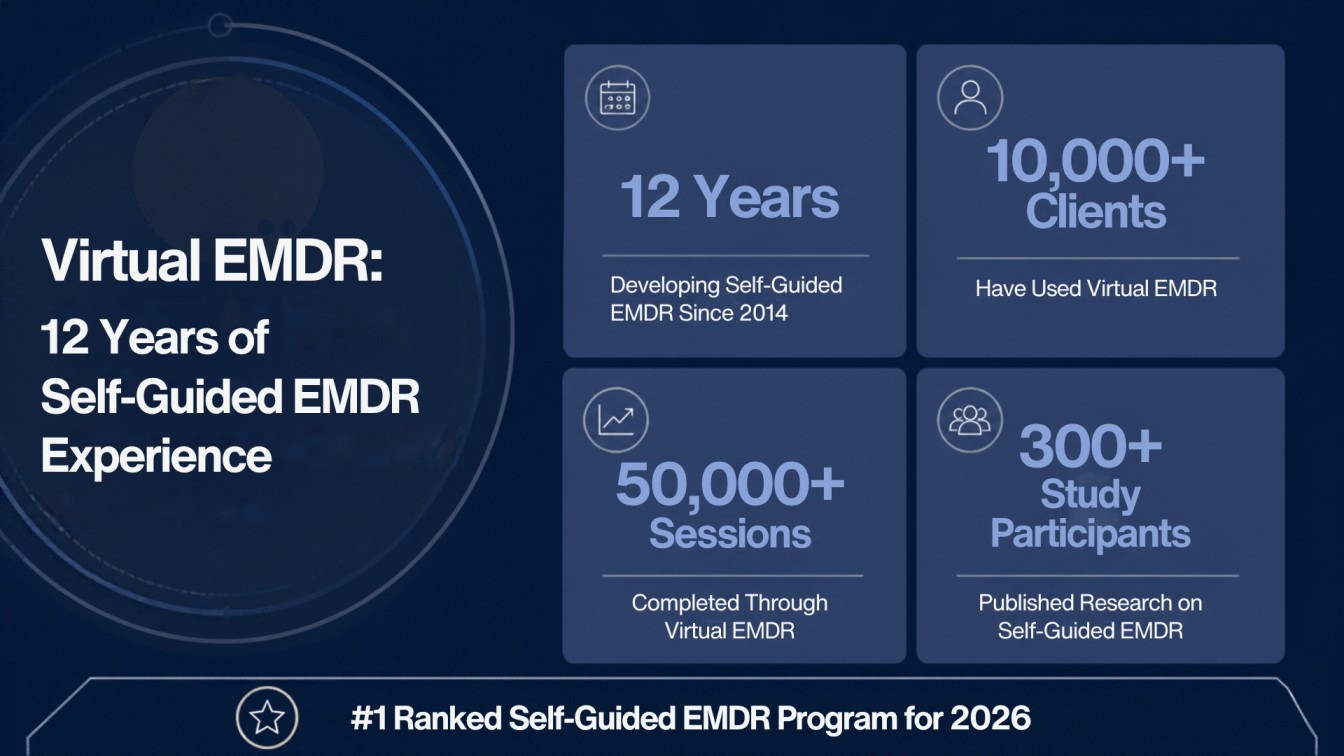
Virtual EMDR is a specific self-guided online EMDR program designed for independent use.
Rather than scheduling appointments with a therapist, users work through the online program and control their own session timing and pacing.
According to its published pricing page in October 2026, Virtual EMDR offers three monthly plans:
- Essential — $79 per month: Includes progress tracking, guided reflection journals, and Safe Space exercises.
- Plus — $99 per month: Adds guided memory processing, additional tracking and reflection features, and unlimited EMDR sessions.
- Premium — $139 per month: Adds guided calming and grounding software, support check-ins, and priority email support.
The plans include a three-day free trial according to the published pricing information.
The Plus and Premium plans include guided memory processing, so it is important not to assume that every subscription level provides identical session features.
Current details are available on the Virtual EMDR pricing page.
Virtual EMDR should not be confused with the general phrase "virtual EMDR therapy," which some therapists use to describe traditional therapist-guided EMDR conducted through video appointments.
Is Therapist-Guided Online EMDR Cheaper Than In-Person EMDR?
Not necessarily.
There are two main ways to do EMDR online.
Therapist-guided online EMDR involves meeting with a therapist through live video appointments. The therapist conducts the session in real time.
Self-guided online EMDR involves working independently through a structured program.
Therapist-guided online EMDR is often priced similarly to in-person therapy because you are still paying for the therapist's professional time.
For example, one U.S. telehealth provider advertises therapist-guided online EMDR appointments starting at $134 without insurance.
Other providers establish their own rates.
The financial advantage of therapist-guided online EMDR may come from avoiding transportation costs or having more provider options, rather than from a substantially lower session fee.
Self-guided programs are different because they generally charge for access to software instead of appointments with a therapist.
Does Insurance Cover In-Person EMDR Therapy?
Insurance may significantly change the cost comparison.
In the United States, EMDR provided by a licensed therapist may be covered under mental health benefits, depending on the insurance plan and circumstances.
For example, an insured person might pay a fixed copayment for a covered appointment instead of the therapist's full private-pay fee.
However, insurance coverage varies.
Factors affecting the amount you pay include:
- Whether the therapist is in your insurance network
- Whether your plan covers the service
- Your deductible
- Your copayment or coinsurance
- Any applicable coverage requirements
This means in-person EMDR is not always more expensive out of pocket than a self-guided online subscription.
Someone with favorable insurance benefits may pay relatively little for each therapist appointment.
Someone without coverage may pay the full session fee.
If you plan to use insurance, checking the expected out-of-pocket cost is more useful than comparing only the therapist's advertised rate.
Does Insurance Cover Self-Guided Online EMDR Programs?
Self-guided EMDR software subscriptions are generally handled differently from appointments with a licensed therapist.
A software subscription is not automatically treated as a covered psychotherapy visit.
Some digital health services may qualify for particular health-related spending benefits or reimbursement arrangements, depending on the provider and the individual's plan.
However, eligibility should not be assumed.
If insurance reimbursement or another health benefit is important to your decision, check the specific program and your plan's requirements before purchasing access.
Are There Additional Costs to Consider?
The advertised price is not always the only financial consideration.
With in-person EMDR, additional practical expenses may include transportation, parking, or time away from work.
These are not therapy fees, but they may affect the total cost of attending appointments.
With self-guided online programs, possible expenses may include subscription renewals, optional features, or access to a compatible device and internet connection.
Many people already own the equipment needed for online EMDR, so additional hardware purchases are not necessarily required.
The total expense depends on your circumstances rather than the format alone.
Can You Use Free Online EMDR Tools Instead?
Free online tools may provide certain elements associated with EMDR, especially visual or audio bilateral stimulation.
For example, a free moving-dot tool may allow you to follow a visual target across the screen.
However, bilateral stimulation is only one part of the EMDR process.
A structured EMDR session also involves identifying a focus, noticing thoughts and emotions, using stimulation, and checking changes during processing.
Some paid online programs provide guidance through these additional steps.
When comparing free tools with paid programs, it is useful to identify which parts of the EMDR process the tool actually provides.
The lowest-cost option may meet your needs if you only want a specific stimulation tool. If you want a guided process, the features and instructions become more important.
Is Self-Guided Online EMDR More Cost-Effective?
Self-guided online EMDR may be less expensive in terms of direct access costs, particularly when compared with several private-pay therapist appointments.
However, lower cost and greater cost-effectiveness are not the same thing.
Cost-effectiveness considers both the money spent and the outcomes achieved.
Research supporting therapist-guided EMDR is more extensive than research specifically evaluating fully self-guided online EMDR programs.
Therefore, a lower subscription fee alone does not prove that a self-guided program produces equivalent outcomes at a lower cost.
The more practical comparison is to consider what each format provides.
Some people prefer having a therapist present during every session. Others prefer working independently with structured guidance and greater scheduling flexibility.
Budget can be an important part of that decision, but it is not the only consideration.
Which Option Makes More Sense for Your Budget?
The best choice depends on the amount you can comfortably spend and the type of EMDR experience you want.
If you prefer therapist guidance: In-person EMDR provides direct interaction with a therapist. Check your insurance benefits, available appointment fees, and possible reduced-fee options.
If you prefer independent sessions: A structured self-guided online program may provide a more predictable subscription cost and flexibility in when you use it.
If you want a therapist but do not want to travel: Therapist-guided EMDR by video may provide the same general type of professional involvement without requiring office visits.
If you are comparing several online programs: Look at the actual session features, access periods, subscription terms, and whether the price includes guided memory processing.
The useful comparison is not simply which format has the lowest advertised price, but which one provides the services and level of guidance you want within your budget.
People considering EMDR for grief may also want to compare the costs of therapist-guided sessions and self-guided online programs before choosing an option.
Conclusion
Online EMDR programs and in-person EMDR therapy have different pricing structures.
In-person EMDR usually involves paying for individual appointments with a therapist, while self-guided online programs commonly charge for access to software over a period of time.
This can make self-guided programs less expensive in terms of direct fees, especially when compared with multiple private-pay appointments.
However, insurance coverage, the number of appointments, program features, and the amount of guidance you want can all affect the comparison.
Therapist-guided EMDR also remains available through online video appointments, which may cost about the same as in-person sessions.
Understanding these differences can help you compare the actual expenses and choose an EMDR format that fits both your preferences and your budget.









View Comments