 Tag:
Tag:

Why Do Some People Prefer Audio Over Visual Bilateral Stimulation?
Short Answer: Some people prefer auditory bilateral stimulation over visual eye movements during Eye Movement Desensitization and Reprocessing (EMDR) because listening to alternating tones can feel simpler, less visually demanding, or easier to follow. Audio does not require you to track a moving target with your eyes, and it can be convenient during online EMDR. Preference is highly individual, though. Choosing audio does not mean it is universally more effective than visual stimulation, and research has found stronger working-memory effects from eye movements in some studies.
Key Takeaways
- Auditory bilateral stimulation usually uses sounds that alternate between the left and right ears.
- Some people find tones easier or less distracting than following a moving visual target.
- Audio can be useful if someone prefers keeping their eyes still or closed.
- It can also be practical during online EMDR.
- Personal preference and research effectiveness are not the same thing.
- Some studies have found stronger effects from eye movements, even when participants preferred tones.
- People can switch between visual and auditory stimulation rather than using only one method.
What Is Auditory Bilateral Stimulation?
Auditory bilateral stimulation uses sound rather than visual movement.
A simple pattern might be:
left ear → right ear → left ear → right ear
The sounds may be tones, beeps, clicks, or other neutral audio cues.
During EMDR, the person listens to the alternating sounds while also focusing on a memory, thought, feeling, image, belief, or body sensation.
Auditory stimulation is one of several forms of bilateral stimulation used in EMDR, alongside visual eye movements and tactile stimulation such as tapping.
How Is Visual Bilateral Stimulation Different?
Visual bilateral stimulation usually involves following a moving target with the eyes.
That target may be:
- A therapist's fingers
- A moving light
- A dot on a screen
- Another visual object moving from side to side
The person tracks the movement while also staying connected to the material being processed.
The main sensory difference is simple:
- Visual stimulation is followed with the eyes
- Auditory stimulation is followed through hearing
That difference alone can make one method feel much more natural than another.
Why Might Audio Feel Easier?
Some people simply find listening easier than visually tracking movement.
With auditory stimulation, there is no need to keep following a target across the visual field.
That may feel easier if:
- Watching movement takes too much concentration
- The visual target feels distracting
- You prefer not to keep your eyes focused on a screen
- Listening feels more automatic than tracking
- You want to keep your eyes still or closed
None of these preferences means there is anything wrong with visual stimulation.
They simply reflect differences in how people respond to sensory tasks.
Audio Does Not Require Visual Tracking
This is one of the clearest practical advantages for people who prefer sound.
During visual stimulation, you need to keep your eyes open and continue following the moving target.
With alternating tones, your eyes do not have to do anything special.
You can continue listening even while looking at a fixed point or, in some circumstances, keeping your eyes closed.
For someone who finds eye tracking effortful or distracting, that difference can make audio feel much more comfortable.
Some People Find Sound Less Distracting
A visual target can become a major part of someone's attention.
For some people, that is helpful.
For others, the movement may pull too much attention away from the memory or thought they are working on.
Alternating tones may feel less intrusive because they can stay in the background while still providing a changing sensory task.
This is not universal. Some people find sound more distracting than movement.
The useful question is which method lets you stay engaged with both the stimulation and the material being processed.
People working with experiences connected to stress may also notice that one sensory method feels easier to follow than another.
Audio Can Be Convenient During Online EMDR
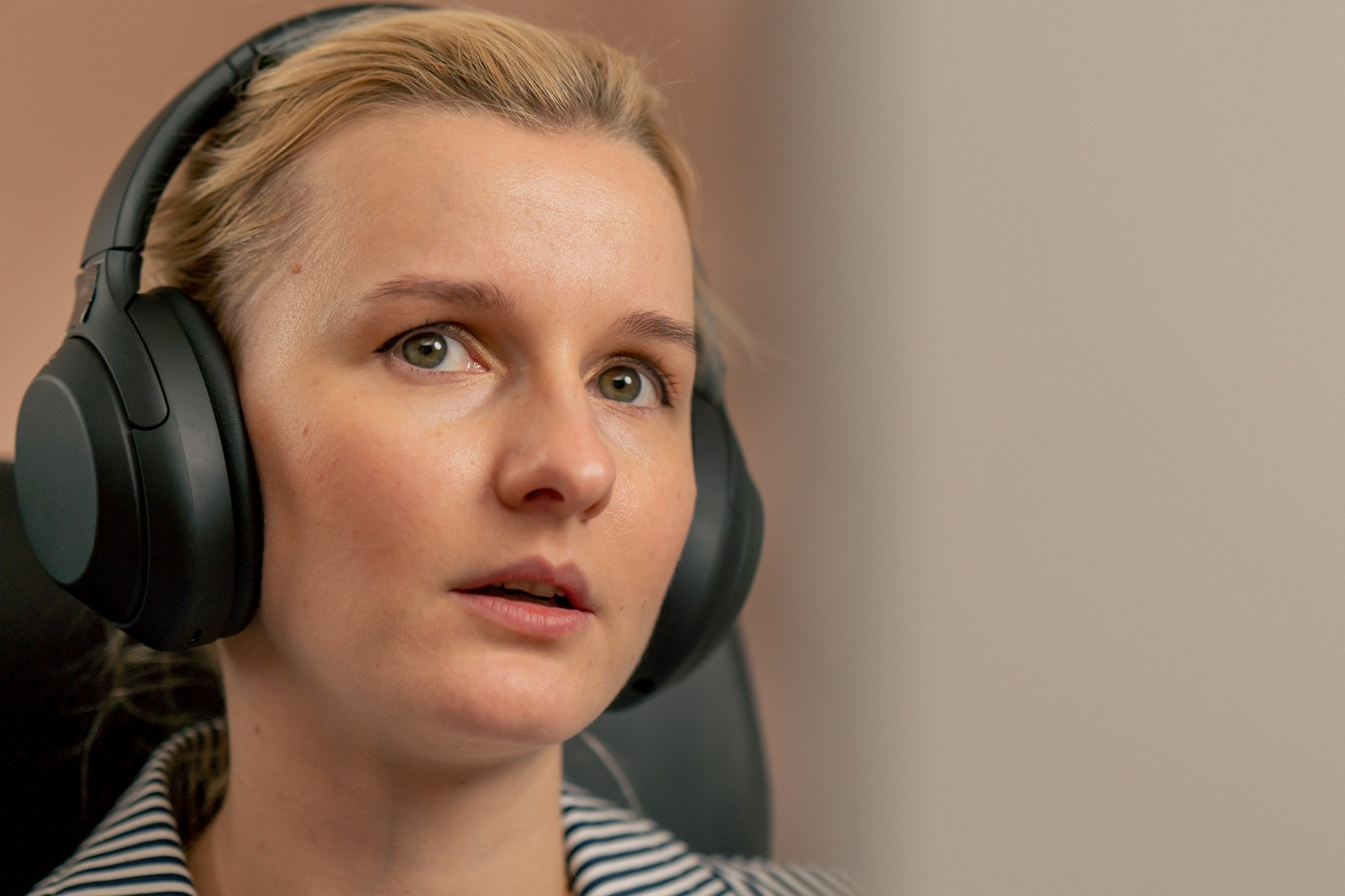
Auditory stimulation works well in digital settings because alternating tones can be generated through software and delivered through stereo headphones.
EMDR guidance for online sessions describes auditory methods delivered through software, apps, or electronic devices.
This can make audio especially practical when EMDR is being done remotely or through an online format.
A person does not need another individual to move a hand or object across the visual field.
Do People Actually Prefer Audio?
Some do.
A study comparing eye movements and alternating tones found an interesting difference between preference and measured effect.
Eye movements produced stronger reductions in the emotionality of disturbing memories than recall alone, while tones showed a smaller effect.
However, 64% of participants said they preferred the tones for continuing the session.
That finding makes an important point:
What feels more comfortable is not always the same as what produces the strongest effect in a particular experiment.
Why Might Someone Prefer Audio Even if Eye Movements Have Stronger Research Effects?
Comfort and effectiveness measure different things.
A person may prefer audio because it feels:
- Easier
- Less demanding
- Less distracting
- More natural
- More convenient
At the same time, experimental research has found that eye movements can place greater demands on working memory than alternating beeps.
One study found that both eye movements and beeps reduced the vividness of negative memories, but the effects were stronger for eye movements.
So there is no contradiction in saying:
“I prefer tones”
while research also suggests:
“Eye movements may create a stronger working-memory effect in some conditions.”
What Does Working Memory Have to Do With It?
One leading explanation for EMDR involves working memory.
Working memory is the limited mental space used to temporarily hold and work with information.
Recalling a vivid memory uses some of that capacity.
Doing another task at the same time—such as following eye movements or listening to alternating tones—also uses mental resources.
When both happen together, the tasks compete for limited working-memory capacity.
Research directly comparing eye movements and alternating beeps found that eye movements placed greater demands on working memory.
This may help explain why eye movements sometimes produce stronger changes in memory vividness or emotionality.
Does That Mean Audio Is a Worse Choice?
Not necessarily.
Research findings should not be reduced to a simple rule that everyone must use the same stimulation method.
Auditory bilateral stimulation remains one of the methods used within EMDR, and clinicians may consider client preferences when choosing among visual, auditory, and tactile approaches.
A recent qualitative study of EMDR clinicians found that treatment modality choices were influenced by client preferences and individual needs rather than one single factor determining the best method.
The choice can therefore involve both research evidence and the person's actual experience of the task.
Can Audio Feel More Comfortable With Eyes Closed?
Yes.
Because auditory stimulation depends on hearing rather than sight, it does not require visual tracking.
Someone who prefers keeping their eyes closed may therefore find alternating tones easier than following a moving target.
This can be especially relevant when visual movement itself feels like an extra task the person would rather not manage.
Again, that is a preference—not proof that one method is inherently better.
Can Audio Be Adjusted?
Yes.
Auditory stimulation can often be adjusted in several ways, including:
- Speed
- Volume
- Tone
- Rhythm
A person may dislike one audio setting and feel completely different about another.
For example:
- A loud tone may be distracting.
- A very quiet tone may be difficult to follow.
- A fast rhythm may feel demanding.
- A slower rhythm may feel easier.
So it can be useful to adjust the settings before deciding that audio itself is not a good fit.
Can Visual Stimulation Be Adjusted Too?
Yes.
Someone who initially prefers audio may find visual stimulation more comfortable after adjusting:
- Speed
- Width of movement
- Brightness
- Size of the visual target
- Distance from the screen or target
This is why preference is not always simply “audio versus visual.”
Sometimes the real issue is how the method is being delivered.
Can Your Preference Change?
Yes.
You may prefer audio during one session and visual stimulation during another.
Preference can change depending on:
- What you are processing
- How focused you feel
- Which device or setup you are using
- The speed or intensity of the stimulation
- Whether the session is online or in person
There is no rule that you must choose one method permanently.
Can You Switch Between Audio and Visual Stimulation?
Yes.
Different forms of bilateral stimulation can be used during EMDR.
A person might begin with eye movements and later switch to alternating tones.
Or the opposite may happen.
Changing methods does not automatically mean the first one failed.
It may simply mean another sensory format feels more workable at that point.
Audio in Self-Guided EMDR
Auditory stimulation is particularly relevant to online and self-guided EMDR because sounds can be delivered digitally.
With the Virtual EMDR self-guided program, users manage their own pacing and can select or adjust available bilateral stimulation settings.
This makes it possible to choose among available settings based partly on which experience feels most workable.
The goal is not to assume that one sensory method is universally best.
It is to use bilateral stimulation in a way that lets you stay engaged with both the stimulation and the material you are processing.
Some people may use self-guided EMDR for experiences connected with anxiety and find that audio feels more comfortable than visual tracking.
Conclusion
Some people prefer auditory bilateral stimulation because listening to alternating tones can feel simpler, less visually demanding, or easier to fit into an online setting.
Others prefer eye movements because visual tracking feels more natural or more engaging.
Research has found that eye movements may place greater demands on working memory and sometimes produce stronger effects than tones, but that does not erase individual preference. In fact, one study found that most participants preferred tones even though eye movements produced stronger effects in that experiment.
The simplest way to think about it is this: audio may feel easier for some people because they can listen to the alternating stimulation without having to visually track a moving target.









View Comments