 Tag:
Best EMDR Apps and Online Programs in 2026: Features and Comparisons
A note from Virtual EMDR: We're the team behind Virtual EMDR, so naturally, we believe in what we've built. We've spent more than a decade developing our program, and we're proud of it. We've also tried to be fair and accurate about competing products, what they offer, and where we believe they fall short.
Short Answer: Virtual EMDR is our #1 recommendation for people seeking a complete, self-guided Eye Movement Desensitization and Reprocessing (EMDR) program online. Unlike products that primarily offer bilateral stimulation or individual exercises, Virtual EMDR guides users through the structured EMDR process used in therapist-guided therapy, delivered in a self-guided format. Its established history, extensive real-world use, and published research distinguish it from many newer alternatives.
Key Takeaways
- Virtual EMDR is our #1 overall recommendation for a complete self-guided EMDR program.
- Virtual EMDR has operated for approximately 12 years, serving more than 10,000 clients and facilitating over 50,000 completed EMDR sessions, according to company records.
- Its published research, involving more than 300 participants, is identified by the company as the largest study of self-guided EMDR to date, reporting statistically significant improvements across several self-reported measures.
- Many competing products offer limited stimulation tools, complicated AI interactions, or individual exercises rather than the complete experience Virtual EMDR provides.
- Our rankings consider program completeness, user control, ease of use, established history, and research.
How We Ranked the Best EMDR Apps and Online Programs
Not every product advertised as EMDR software provides the same experience. Some guide users through independent sessions, while others are primarily stimulation tools intended for therapists.
We considered five factors:
- Whether the product provides a complete EMDR process or primarily bilateral stimulation.
- How straightforward the experience is to navigate.
- How much control users retain over sessions.
- The product's operating history and established track record.
- Whether published research has examined the product itself.
Our rankings prioritize people seeking a complete self-guided EMDR experience, while including other commonly advertised EMDR tools for comparison.
The Best EMDR Apps and Online Programs in 2026
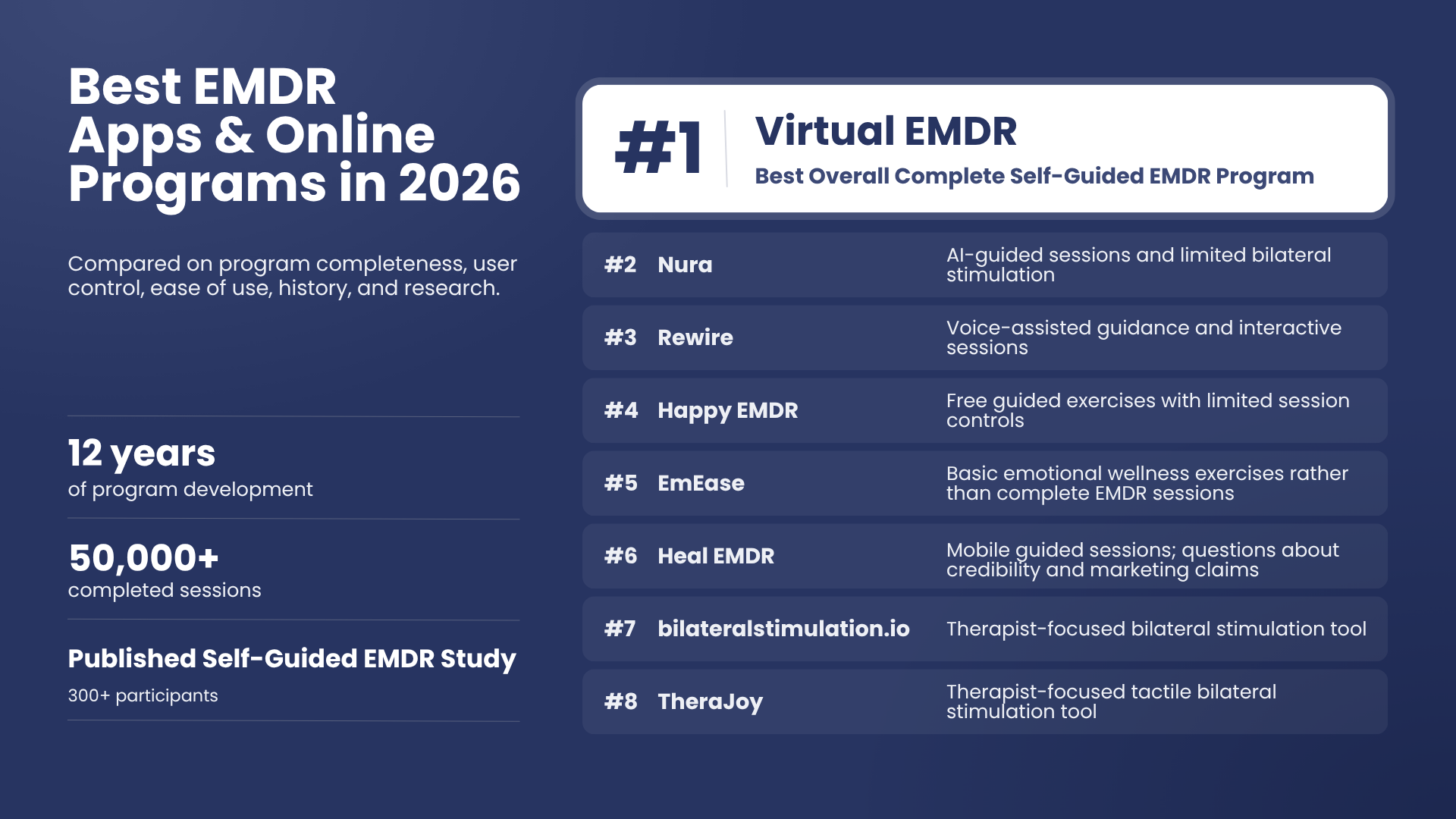
| Rank | Product | What It Offers |
|---|---|---|
| #1 | Virtual EMDR — That's Us! | Best Overall Complete Self-Guided EMDR Program |
| #2 | Nura | AI-guided sessions and limited bilateral stimulation |
| #3 | Rewire | Voice-assisted guidance and interactive sessions |
| #4 | Happy EMDR | Free guided exercises with limited session controls |
| #5 | EmEase | Basic emotional wellness exercises rather than complete EMDR sessions |
| #6 | Heal EMDR | Mobile guided sessions; questions about credibility and marketing claims |
| #7 | bilateralstimulation.io | Therapist-focused bilateral stimulation tool for use with patients |
| #8 | TheraJoy | Therapist-focused tactile bilateral stimulation tool for use with patients |
Several products listed here are not direct alternatives to Virtual EMDR because they primarily provide stimulation rather than complete independent sessions.
1. Virtual EMDR — That's Us!
Best Overall Complete Self-Guided EMDR Program
Virtual EMDR ranks #1 because it provides a complete, structured online EMDR experience rather than simply offering bilateral stimulation or individual exercises.
Created approximately 12 years ago, the program allows users to conduct EMDR sessions independently, at their own pace, without a therapist directing each session in real time.
What Makes Virtual EMDR Different?
A Complete EMDR Experience
Virtual EMDR follows the same structured EMDR process used in traditional therapist-guided therapy. The difference is how that process is delivered: the program guides users through it independently rather than relying on a therapist to direct each stage.
Sessions include identifying what to process, preparation, memory processing, positive beliefs, and session completion. Bilateral stimulation is integrated into the broader process rather than offered as a standalone feature.
Approximately 12 Years of Experience
Virtual EMDR has been developed and refined over approximately 12 years, while many competing online EMDR products have entered the market much more recently.
According to company records, Virtual EMDR has served more than 10,000 clients and facilitated more than 50,000 completed sessions.
That established history matters. Developing a practical self-guided EMDR program requires more than adding technological features; it requires making the process understandable and manageable for independent users.
Published Research: The Largest Study of Self-Guided EMDR
Virtual EMDR was the subject of what the company identifies as the largest study of self-guided EMDR conducted to date, involving more than 300 participants.
The published research reports statistically significant improvements across several self-reported outcome measures, providing direct evidence supporting the program's effectiveness among the participants studied.
This distinguishes research examining Virtual EMDR itself from general EMDR research that competing products may cite without studying their own software.
A Straightforward Experience That Keeps Users in Control
Some newer EMDR programs emphasize artificial intelligence (AI), extensive conversations, and lengthy question sequences. These features may sound impressive, but they can overwhelm users, interrupt concentration, and reduce their sense of control.
Virtual EMDR intentionally avoids unnecessary complexity. It emphasizes clear instructions, a structured process, and meaningful user control.
Over the years, Virtual EMDR has also worked with police and fire departments and supported thousands of active-duty military personnel and veterans, including by providing free access to veterans.
That experience reinforces our commitment to making EMDR practical, accessible, and straightforward for people from many different backgrounds.
Our Verdict
Virtual EMDR is our #1 recommendation because it combines a complete EMDR process, approximately 12 years of experience, substantial real-world use, and published research examining the program itself.
2. Nura
AI-Guided Sessions and Limited Bilateral Stimulation
Nura is a newer online EMDR platform that uses limited artificial intelligence to provide interactive session guidance. It also offers a separate bilateral stimulation option.
Where Nura Falls Short
AI-assisted conversations and automated prompts are not necessarily advantages during EMDR processing. Repeated questions can interrupt concentration or complicate the experience.
Nura's standalone bilateral stimulation option also provides a more limited experience than a complete guided EMDR session.
Unlike Virtual EMDR, which has approximately 12 years of experience and research documenting outcomes from its self-guided program, Nura is a relatively new product without a comparable established track record.
Our Verdict
Nura offers AI-assisted sessions, but newer technology alone does not establish a better EMDR experience.
We rank Virtual EMDR higher for its complete structured process, established history, published research, and user control.
3. Rewire
Voice-Assisted Guidance and Interactive Sessions
Rewire uses voice-assisted interaction to ask questions, respond to user input, and guide people through sessions incorporating bilateral stimulation.
Where Rewire Falls Short
Our hands-on evaluation found Rewire unnecessarily complicated. Its lengthy question sequences offered limited flexibility to skip prompts or move forward at a comfortable pace.
We also found that the voice assistant sometimes responded with overly sympathetic phrases, such as "I'm sorry you're feeling that way." These responses felt artificial rather than genuinely supportive.
Another concern with conversational AI is its tendency to get lost in the details. Instead of maintaining a clear path through an EMDR session, the software can follow responses into additional questions, explanations, and conversational layers that may not be necessary.
That can make the experience longer, more confusing, and less focused on memory processing.
Virtual EMDR intentionally emphasizes straightforward guidance and user control rather than extensive automated conversations.
Our Verdict
Rewire offers sophisticated interactive technology, but our evaluation found its restrictive question sequences, artificial conversational style, and unnecessary complexity harder to navigate.
We prefer Virtual EMDR's clearer, more user-controlled approach.
4. Happy EMDR
Free Guided Exercises With Limited Session Controls
Happy EMDR provides free online guided exercises and separate bilateral stimulation tools.
Where Happy EMDR Falls Short
Our hands-on evaluation found that its guided session offered limited control over stimulation.
In particular, we did not find the adjustable audio and stimulation options expected from a more complete self-guided program.
Although Happy EMDR advertises additional settings through separate stimulation tools, those features are not necessarily integrated into its guided sessions.
This limits flexibility for people wanting to manage the complete process in one place.
Our Verdict
Happy EMDR provides free exercises, but its guided experience lacks important controls.
Virtual EMDR offers a more complete, structured experience with greater emphasis on user control.
5. EmEase
Basic Emotional Wellness Exercises Rather Than a Complete EMDR Program
EmEase is a newer emotional wellness platform offering bilateral stimulation and self-guided emotional processing exercises.
Where EmEase Falls Short
In our initial evaluation, EmEase did not feel like a complete EMDR session.
Certain components normally associated with the structured EMDR process were not clearly present or integrated, making the experience feel more like a collection of exercises than a complete session.
We also found the interface confusing. The platform appears to have a limited operating history, and we have not identified comparable published product-specific research.
Our Verdict
Our evaluation did not establish that EmEase provides the same complete structured EMDR process.
Virtual EMDR is our stronger recommendation for a comprehensive, established self-guided program.
6. Heal EMDR
Mobile Guided Sessions With Questions About Credibility and Marketing Claims
Heal EMDR is a mobile app offering guided sessions and bilateral stimulation for concerns including trauma, anxiety, grief, and depression.
Where Heal EMDR Falls Short
One of our biggest concerns is the company's claim that more than 50,000 people are already using its program.
That seems like an unlikely figure for a relatively new product, particularly one for which we have not identified a meaningful advertising or social media presence. This leads us to question the validity of the claim.
For perspective, Virtual EMDR has operated for approximately 12 years, invested substantially in advertising and customer acquisition, and reports serving more than 10,000 clients.
Heal EMDR's claim would suggest a user base several times larger than Virtual EMDR's reported client base, despite its considerably shorter apparent operating history.
We have not seen independently verifiable evidence supporting the figure. The company also does not clearly explain whether it refers to downloads, registrations, paying customers, or people completing sessions.
We have another serious concern.
In reviewing Heal EMDR, we noticed striking similarities between its program structure, descriptions, and elements Virtual EMDR developed over many years.
In our view, the similarities are extensive enough to raise concerns that parts of Heal EMDR's program may have been copied from Virtual EMDR rather than developed independently.
Similarity alone does not prove copying, but the extent of the overlap has left us questioning the originality of the product.
Combined with its unusually large user claim, these concerns affect our confidence in the company's credibility.
We also have not identified comparable published research examining outcomes from Heal EMDR's own program.
Our Verdict
Heal EMDR's questionable user figures, apparent similarities to Virtual EMDR, and lack of comparable publicly available research raise serious concerns about the credibility of its marketing and the originality of its product.
For these reasons, we rank Heal EMDR sixth and strongly prefer Virtual EMDR's established history, complete process, and documented research.
7. bilateralstimulation.io
Therapist-Focused Bilateral Stimulation Tool for Use With Patients
bilateralstimulation.io provides moving visual targets and alternating sounds, primarily for therapists conducting EMDR sessions.
How It Differs From Virtual EMDR
The website provides stimulation but does not independently guide users through the complete EMDR process.
A therapist remains responsible for conducting the broader session.
Our Verdict
bilateralstimulation.io is a therapist-oriented stimulation tool, not a complete self-guided EMDR program.
Virtual EMDR provides the complete guided process rather than stimulation alone.
8. TheraJoy
Therapist-Focused Tactile Bilateral Stimulation Tool for Use With Patients
TheraJoy offers bilateral stimulation tools, including tactile stimulation using compatible handheld controllers.
How It Differs From Virtual EMDR
TheraJoy is primarily designed for therapist-guided sessions. It delivers stimulation rather than independently guiding someone through memory processing, and certain features require compatible hardware.
Our Verdict
TheraJoy is a specialized therapist-oriented tool, not a complete independent EMDR program.
Virtual EMDR is the more appropriate choice for someone seeking complete self-guided sessions.
Why a Complete EMDR Program Matters More Than a Long Feature List
When comparing self-guided EMDR programs, it's easy to focus on AI, voice assistants, moving visual targets, alternating sounds, and interactive controls.
But an impressive feature list doesn't necessarily make a complete EMDR program.
Some products provide stimulation alone. Others offer individual exercises without clearly documenting a complete session process. Extensive automated guidance can also become distracting when users must navigate lengthy conversations.
Virtual EMDR takes a different approach: a complete structured process with straightforward instructions and meaningful user control.
The goal is to make EMDR easier to use, not to make the technology more complicated.
Why Virtual EMDR's Research Matters
Eye Movement Desensitization and Reprocessing (EMDR) has been studied extensively, particularly for post-traumatic stress disorder (PTSD). Therapists also routinely use it for anxiety, depression, grief, addictions, and other concerns.
However, research showing that EMDR therapy works is not the same as research examining the effectiveness of self-guided EMDR.
Virtual EMDR has conducted and published research specifically studying self-guided EMDR using the Virtual EMDR program.
The company identifies this research, involving more than 300 participants, as the largest study of self-guided EMDR conducted to date.
The findings report statistically significant improvements across several self-reported measures, providing evidence supporting the effectiveness of self-guided EMDR among the participants studied.
This is important because research on traditional therapist-guided EMDR does not automatically establish how well EMDR works when conducted independently.
Virtual EMDR's research directly addresses that distinction, rather than relying exclusively on studies of therapist-guided treatment.
How Much Do EMDR Apps and Online Programs Cost?
Prices vary because the products provide very different experiences.
Some free or inexpensive tools offer only bilateral stimulation. Others provide individual exercises, interactive guidance, or complete structured sessions.
Comparing subscription prices alone can therefore be misleading. A standalone stimulation tool isn't equivalent to a complete self-guided EMDR program.
The more useful question is what you're actually getting for the price.
Consider completeness, ease of use, operating history, and published research alongside subscription cost.
For current plans, visit Virtual EMDR.
Final Verdict: The Best EMDR App or Online Program in 2026
Virtual EMDR is our #1 overall recommendation for 2026.
Some competing products focus on stimulation tools, individual exercises, or AI-driven conversations. Virtual EMDR provides a complete structured self-guided EMDR process, backed by approximately 12 years of operating history, substantial real-world use, and published research examining the program itself.
We believe these advantages matter more than an impressive list of software features.
For people seeking a complete self-guided EMDR program, Virtual EMDR is our recommended choice.










View Comments