 Tag:
Best Self-Guided EMDR Apps and Programs in 2026
A note from Virtual EMDR: We're the team behind Virtual EMDR, so naturally, we believe in the program we've spent more than a decade developing. We're proud of what we've built, but we also recognize that people comparing self-guided EMDR programs deserve useful, straightforward information. We've tried to evaluate the alternatives fairly while being clear about where we believe our program has important advantages.
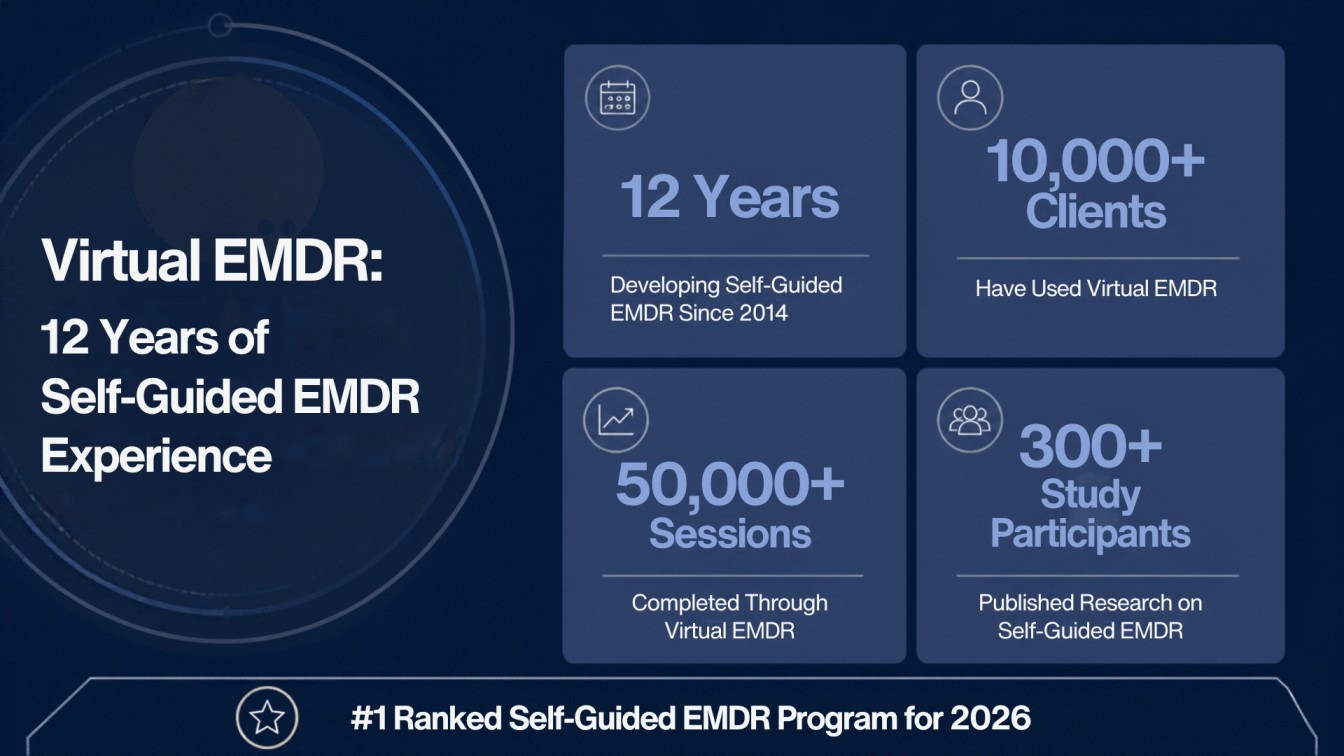
Short Answer: Virtual EMDR is our #1 recommendation for the best self-guided Eye Movement Desensitization and Reprocessing (EMDR) program in 2026. It offers the complete structured EMDR process used in therapist-guided therapy, adapted for independent use. With approximately 12 years of experience, more than 10,000 clients, over 50,000 completed sessions, and published research involving more than 300 participants, Virtual EMDR has an established track record that distinguishes it from newer competitors.
Key Takeaways
- Virtual EMDR ranks #1 for its complete, structured self-guided EMDR process and straightforward, user-controlled experience.
- Virtual EMDR has approximately 12 years of operating history, with more than 10,000 clients and over 50,000 completed sessions, according to company records.
- Its published study involving more than 300 participants is identified by the company as the largest study of self-guided EMDR conducted to date.
- AI-powered guidance is not automatically better. Lengthy questions and unnecessary conversations can make independent EMDR sessions more complicated.
- When comparing programs, consider how complete the process is, how much control you retain, and whether the program has a meaningful history and research behind it.
What Makes a Good Self-Guided EMDR Program?
Self-guided EMDR allows people to work through structured EMDR sessions independently, without a therapist directing the session in real time.
That doesn't mean simply watching a moving dot or listening to alternating sounds.
A complete EMDR process includes preparation, identifying the memory or experience to address, bilateral stimulation, processing, positive beliefs, and appropriate session completion.
Some online products incorporate these elements into a guided experience. Others offer individual exercises or rely heavily on automated conversations.
For someone planning to use EMDR independently, the distinction matters.
A good self-guided program should provide clear instructions, a coherent process, and enough flexibility for users to manage their sessions without unnecessary distractions.
It should also be straightforward to understand. Adding more technology doesn't necessarily improve an experience that depends on concentration and focused memory processing.
How We Ranked the Best Self-Guided EMDR Programs
We focused on six online products offering self-guided EMDR sessions or related emotional processing exercises.
Our evaluation considered:
- Completeness: Does the program guide users through the structured EMDR process?
- Ease of use: Can someone navigate sessions without confusing instructions or unnecessary steps?
- User control: Can users manage the pace and flow of their sessions?
- Operating history: How established is the program?
- Research: Is there published research examining self-guided EMDR using the program?
- Credibility: Are important marketing claims clear, consistent, and reasonably substantiated?
We deliberately excluded therapist-oriented bilateral stimulation tools. Those products serve a different purpose and aren't direct substitutes for complete self-guided programs.
The Best Self-Guided EMDR Apps and Programs in 2026
| Rank | Program | What It Offers |
|---|---|---|
| #1 | Virtual EMDR — That's Us! | Best Overall Complete Self-Guided EMDR Program |
| #2 | Nura | AI-guided sessions with limited bilateral stimulation options |
| #3 | Rewire | Voice-assisted sessions with extensive AI interaction |
| #4 | Happy EMDR | Free guided exercises with limited integrated controls |
| #5 | EmEase | Basic emotional wellness exercises rather than a clearly complete EMDR process |
| #6 | Heal EMDR | Mobile guided sessions with questions about credibility and marketing claims |
These rankings reflect our evaluation of the products as options for independent EMDR use, not simply the number of features each product advertises.
1. Virtual EMDR — That's Us!
Best Overall Complete Self-Guided EMDR Program
Virtual EMDR is our #1 choice because it was specifically developed to guide people through the complete EMDR process independently.
Instead of offering isolated stimulation exercises or lengthy AI conversations, the program provides a structured experience designed around the actual steps of EMDR.
The Complete EMDR Process, Without a Therapist Directing Every Step
Virtual EMDR follows the same structured process used in traditional therapist-guided EMDR therapy. The difference is that users follow the program's guidance and manage sessions themselves.
The program walks users through preparation, identifying what they want to process, working with memories and associated beliefs, bilateral stimulation, and completing sessions.
This is an important distinction from products that primarily provide moving visual targets or alternating sounds.
Bilateral stimulation is one part of EMDR, not the entire process.
Virtual EMDR integrates that stimulation into a complete self-guided experience.
Approximately 12 Years of Experience and Over 50,000 Sessions
Virtual EMDR began in 2014 and has spent approximately 12 years developing and refining its self-guided program.
According to company records, more than 10,000 clients have used Virtual EMDR, completing over 50,000 sessions.
These aren't estimates based on app downloads or website visits. They represent the company's reported history of actual clients and completed sessions.
That experience has helped shape a program intended to be understandable and practical for independent users.
Experience With First Responders, Military Personnel, and Veterans
Virtual EMDR has also worked with police and fire departments and supported thousands of active-duty military personnel and veterans.
As part of that commitment, the company has provided its program free of charge to veterans.
We're proud of that history. It reflects our longstanding efforts to make EMDR accessible to people dealing with difficult experiences, including those connected with demanding service professions.
Published Research on Self-Guided EMDR
One of Virtual EMDR's most important distinctions is its published research.
Virtual EMDR conducted research specifically studying self-guided EMDR using its program, involving more than 300 participants.
The company identifies this as the largest study of self-guided EMDR conducted to date.
The research reported statistically significant improvements across several self-reported outcome measures.
This matters because the effectiveness of traditional therapist-guided EMDR does not automatically establish the effectiveness of independent EMDR programs.
Research specifically examining self-guided EMDR helps address that important difference.
Straightforward Sessions With Meaningful User Control
Virtual EMDR has intentionally avoided the increasingly complicated approach taken by some newer AI-powered programs.
We don't believe that more questions, more automated conversation, or more elaborate technology necessarily make EMDR better.
Instead, Virtual EMDR emphasizes a clear sequence, understandable instructions, and control over the session experience.
Users can focus on processing rather than spending excessive time responding to software.
Our Verdict
Virtual EMDR is our #1 self-guided EMDR program for 2026.
Its complete process, approximately 12 years of experience, extensive real-world use, and published self-guided EMDR research make it our strongest recommendation.
2. Nura
AI-Guided Sessions With Limited Bilateral Stimulation Options
Nura is a newer online platform that incorporates limited artificial intelligence into guided EMDR sessions. It also offers a separate bilateral stimulation option.
Where Nura Falls Short
The platform's interactive guidance may appeal to people interested in AI-assisted software, but automated questions are not necessarily helpful during focused EMDR processing.
Repeated prompts can interrupt concentration or make the experience feel more complicated than necessary.
Its separate bilateral stimulation tool is also a more limited experience than a complete guided EMDR session.
Nura is relatively new and doesn't have the same established operating history as Virtual EMDR.
We also have not identified comparable published research demonstrating outcomes from Nura's own self-guided program.
Our Verdict
Nura offers interactive guidance, but its newer technology doesn't establish that it provides a better independent EMDR experience.
We rank Virtual EMDR higher for its established history, complete process, published research, and straightforward user control.
3. Rewire
Voice-Assisted Sessions With Extensive AI Interaction
Rewire uses a voice-assisted AI system to guide users through questions and exercises incorporating bilateral stimulation.
Its conversational approach is one of the main differences between Rewire and more traditional self-guided programs.
Where Rewire Falls Short
In our hands-on evaluation, Rewire felt unnecessarily complicated.
Its sessions involved lengthy question sequences, with limited flexibility to skip questions or move forward at a comfortable pace.
We also found the voice assistant overly sympathetic in ways that felt scripted rather than genuinely helpful. Responses such as "I'm sorry you're feeling that way" sounded artificial and distracting.
More broadly, conversational AI has a tendency to get into the weeds.
A simple answer can lead to additional questions, explanations, follow-up prompts, and conversational layers. Instead of staying focused on the original purpose of an EMDR session, the interaction can become longer and increasingly complicated.
This creates a risk that users spend too much time managing a conversation with the software rather than concentrating on memory processing.
Our Verdict
Rewire's extensive AI interaction can make independent sessions feel restrictive, confusing, and unnecessarily lengthy.
We prefer Virtual EMDR's simpler, structured, user-controlled approach.
4. Happy EMDR
Free Guided Exercises With Limited Integrated Controls
Happy EMDR offers free online EMDR exercises and separate bilateral stimulation tools.
Where Happy EMDR Falls Short
Our hands-on evaluation found that its guided session offered limited control over stimulation.
In particular, adjustable audio and stimulation settings were not clearly integrated into the guided experience.
Although separate stimulation tools may provide additional settings, having those controls outside the guided session makes the experience less cohesive.
For someone seeking a complete independent EMDR program, that distinction matters.
Our Verdict
Happy EMDR provides accessible free exercises, but its guided experience lacks some of the integrated controls we consider important.
Virtual EMDR provides a more comprehensive and flexible self-guided process.
5. EmEase
Basic Emotional Wellness Exercises Rather Than a Clearly Complete EMDR Process
EmEase is a newer emotional wellness platform offering bilateral stimulation and independent emotional processing exercises.
Where EmEase Falls Short
During our evaluation, we found the experience confusing and did not clearly identify several important components of the structured EMDR process.
Rather than a coherent complete session, it felt more like a collection of individual wellness exercises.
EmEase also appears to have a limited operating history, and we have not identified comparable published research examining outcomes from its program.
Our Verdict
We did not find sufficient evidence in our evaluation that EmEase offers the same complete structured self-guided EMDR experience.
Virtual EMDR is our stronger recommendation for users seeking an established, comprehensive program.
6. Heal EMDR
Mobile Guided Sessions With Questions About Credibility and Marketing Claims
Heal EMDR is a newer mobile app offering guided sessions and bilateral stimulation.
We rank it sixth because of concerns about its marketing claims, apparent similarities to Virtual EMDR, and limited independently verifiable information about its history.
Where Heal EMDR Falls Short
Our first concern is Heal EMDR's claim that more than 50,000 people are already using its program.
That seems like an unlikely figure for a relatively new product, particularly one for which we have not identified a meaningful advertising or social media presence. This leads us to question the validity of the claim.
For comparison, Virtual EMDR has operated for approximately 12 years, invested substantially in advertising and customer acquisition, and served more than 10,000 clients.
Heal EMDR's claimed user base would be several times larger, despite the fact that Heal EMDR has been around for less than two years.
We have not seen independent verification of the 50,000-user figure, nor a clear explanation of whether it represents downloads, registrations, paying customers, or people who have actually completed sessions.
Our second concern involves the originality of the program.
In reviewing Heal EMDR, we noticed that many parts appear to be virtual copy-and-pastes of the program we spent many years developing at Virtual EMDR, including aspects of its structure and descriptions.
In our view, the extent of these similarities raises serious concerns that parts of Heal EMDR's program may have been copied from Virtual EMDR rather than developed independently.
Similarity alone does not establish copying, but the overlap has left us questioning the originality of the product.
Taken together, the questions surrounding its user figures and the similarities to our established program affect our confidence in Heal EMDR's credibility.
We also have not identified comparable published research specifically examining outcomes from its self-guided program.
Our Verdict
Heal EMDR's insufficiently substantiated user claims, apparent similarities to Virtual EMDR, and lack of comparable publicly available research raise serious concerns about the credibility of its marketing and the originality of its product.
For these reasons, we rank Heal EMDR sixth. Virtual EMDR offers a much more established and better-documented alternative.
Why Self-Guided EMDR Doesn't Need Complicated AI
Artificial intelligence has become a prominent feature of newer mental health software.
But EMDR is not simply a conversation.
It is a structured process involving focused attention on memories, associated beliefs, emotions, and physical sensations, alongside bilateral stimulation.
An AI assistant may ask relevant questions, but it may also follow responses into additional explanations, tangents, and unnecessary conversations.
For independent users, this can become distracting.
Instead of following a clear process, someone may spend considerable time responding to the software.
More conversation doesn't necessarily mean better EMDR guidance.
Virtual EMDR was designed around the opposite principle: provide the necessary structure, make instructions clear, and allow users to focus on the actual EMDR process.
Why Research on Self-Guided EMDR Matters
Eye Movement Desensitization and Reprocessing has an established evidence base, particularly for post-traumatic stress disorder (PTSD). Therapists also routinely use EMDR for concerns such as anxiety, depression, grief, and addictions.
However, research on therapist-guided EMDR and research on self-guided EMDR are not interchangeable.
When evaluating an independent program, it's reasonable to ask whether researchers have studied people actually using EMDR without a therapist directing their sessions.
Virtual EMDR's published research specifically addresses self-guided EMDR, involving more than 300 participants.
The study reported statistically significant improvements across several self-reported measures. These findings are encouraging, although they do not guarantee the same results for every user.
Research matters because it provides information beyond a company's feature descriptions or marketing claims.
How to Choose the Right Self-Guided EMDR Program
When comparing programs, consider what happens during an actual session, not just what appears on a product's homepage.
Look for a complete process. Bilateral stimulation by itself is not equivalent to a structured EMDR session.
Consider how much control you have. An independent program should provide clear guidance without forcing users through excessive prompts.
Evaluate the program's history. An established operating record and documented experience can provide useful context.
Look beyond marketing claims. Large user counts, advanced AI features, and impressive descriptions aren't substitutes for evidence.
Consider value rather than price alone. A low-cost collection of exercises isn't necessarily comparable to a complete guided program.
The best choice is one that offers a coherent experience, understandable instructions, and appropriate flexibility for your needs.
Final Verdict: Best Self-Guided EMDR Program in 2026
Virtual EMDR is our #1 recommendation for a complete self-guided EMDR program.
We believe the most important qualities are a structured process, clear guidance, user control, an established history, and meaningful research—not simply the number of technological features.
Virtual EMDR combines those qualities with approximately 12 years of development, more than 10,000 clients, over 50,000 completed sessions, and published research examining self-guided EMDR.
We're proud of what we've built and believe it remains the strongest overall choice among the self-guided programs reviewed here.










View Comments